


Board Recruitment 2026
Who we are
 Changing Relations is an organisation that engages with issues around sexual relations, domestic abuse, and social justice. We occupy a vital space in advocating for equality, challenging oppression, and empowering those who have experienced trauma and marginalisation. We are an arts education company, meaning that we use the arts and creativity as the tool to challenge thinking around relationship behaviours and gender stereotypes. Our work is co-produced with those affected by the issues we address and we look to multiply our impact by using our artistic output for learning, training and awareness-raising with young people, professionals and community members.
We have been in operation for over 12 years, surviving a tough economic climate, changes in government and the pandemic. At the moment, we are a Community Interest Company Limited by Guarantee, however, we are looking to become a Charitable Incorporated Organisation in the next year. Therefore, anyone applying to join our Board, needs to be aware of the responsibilities associated with being a charity Trustee.
Having recently joined the North East Anti-Racism Coalition, we are committed to anti-racist practice, and are keen to bring in different perspectives to support the development of our work going forward.
Image credit Tracy Thomas
How we work
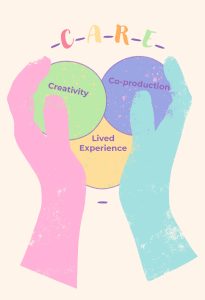 In the 2025 Culture Health and Wellbeing Awards, we were Highly Commended in the Practising Well category for demonstrating mutual care throughout all stages of a project, and at all staff levels, demonstrating a deep commitment to the wellbeing of both freelancers and staff.
How we work with our board reflects how we work with our teams. We alternate business-focused board meetings with meetings more focused on ways of working. This care-led approach makes a difference to how meetings are transacted: we are coproducing our governance and organizational culture as we coproduce together with our participants.
We very much see board membership as a two-way mentoring process. Yes, we are looking for strategic guidance and constructive challenge. But we also want to create a space where you can develop and feel supported in going back into the challenges you face in your day-to-day work. It’s a conversation.
In working with sensitive themes, and with those on our teams and amongst our participants often having been affected by challenging lived experiences, we are conscious that being on our board means supporting us to hold space for things of an emotional nature. We believe it is important to be open and reflective about this, considering what this means for our board members and what support they may need.
As a team, we are emotionally open, informal, flexible, creative, neuro-affirmative. We are strongly values-driven. We don’t want to grow at the expense of care, quality and culture.
Image credit Kate Gorman
What we are looking for
We are looking for at least two new board members, but ideally four. As we are looking to transition to charitable status, we need board members who are happy to take on the prescribed roles of Treasurer, Secretary and Chair.
We have outlined a set of values, knowledge and experience we are looking for in our new board members. But please note that we absolutely do not expect everyone who applies to be able to demonstrate every single entry in our list!
Core Values and Commitment
- Alignment With Feminist Principles: demonstration of a deep commitment to feminist values, including the belief in the inherent equality and dignity of all genders. This includes an essential understanding of intersectionality. This is crucial in willingness to articulate the ways in which gender interacts with race, class, sexuality, disability, neurodiversity and other identities.
- Commitment to Social Justice: passion and commitment for dismantling systems of oppression that perpetuate inequality, violence, and marginalisation. This includes a willingness to challenge discriminatory practices and support transformative approaches to justice, & advocating for pedagogical approaches that might challenge dominant and persistent systems and structures.
- Trauma-Informed Approach: working with survivors of domestic abuse and sexual violence requires all of us working with Changing Relations to understand the importance of trauma-informed care, creating safe and supportive spaces, avoiding practices that may inadvertently re-traumatise individuals.
- Understanding co-creation and co-design: exploring relational ethics and ethics of care and how this impacts on all those involved in co-creation, co-production and co-design within projects, productions, outputs and funding bids.
Knowledge and Experience
- Understanding of Domestic Abuse and Sexual Relations: trustees must possess, or be willing to develop, a nuanced understanding of the dynamics of domestic abuse, sexual violence, consent, healthy relationships, and the legal, psychological, and social frameworks that surround these topics.
- Governance and Leadership Skills: experience in governance, strategic planning, financial oversight, and risk management would be valuable for the responsible stewardship of the organisation. Networking capabilities and capacity-building skills would support us in the next phase of our organisational development.
- Sectoral Understanding: we are a small VCSE sector organisation balancing charitable fundraising with commercialisation and hoping to leverage corporate sponsorship. It’s important that our board members understand this context, as well as other sectoral frameworks that can be utilised to position the work of Changing Relations, including the Culture sector and the field of Creative Health.
Other considerations
- Robust Safeguarding: trustees must prioritise the safety and wellbeing of beneficiaries, staff, and volunteers by ensuring robust and transparent safeguarding policies and procedures are in place and regularly reviewed.
- Ethical Decision-Making: trustees should be prepared to navigate complex ethical dilemmas, informed by the organisation’s values and a commitment to justice and equity.
- Openness to Creative Methods: trustees should be open to innovative ways of sharing information and gauging responses, valuing creative engagement as a means of deepening understanding and fuller participation.
- Empathy and Compassion: the ability to demonstrate genuine empathy for survivors and those who have been marginalised, including active listening, non-judgmental attitudes, and a commitment to supporting empowerment.
- Cultural Humility: it is vital to approach a governance role with humility and openness to learning, recognising that lived experience and cultural contexts may differ widely among partner organisations, participants, beneficiaries, learners, team members, creative practitioners and audiences.
- Integrity and Accountability: acting with integrity, transparency, congruence, and accountability in all aspects of work, maintaining high ethical standards and putting the needs of the organisation’s beneficiaries first.
- Resilience and Courage: the issues faced by all those involved in project developments are often complex and emotionally demanding. It would be essential that there is a demonstration of flexibility in the face of challenges, rather than rigidity, courage in addressing difficult subjects and curiosity in confronting resistance to change.
- Active Engagement: being proactive in seeking diverse perspectives, encouraging dialogue, and fostering a collaborative environment both within the board and across the organisation.
- Geographical and Sectoral Representation: trustees should bring relevant geographical knowledge and connections, as well as complementary skill sets from other sectors and organisations.
- Strategic Thinking: trustees should be able to think critically and strategically about opportunities for growth, partnership, and innovation, identifying how the organisation can best fulfil its mission in a changing socio-economic landscape.
- Commitment to Evaluation and Learning: encouragement of ongoing learning, reflection, and evaluation to ensure the organisation remains effective, responsive, and accountable to those it serves.
- Ability to Balance Support and Challenge: trustees should be a robust support for the organisation, while also able to offer constructive comments where necessary to advance our aims, strengthen our governance, support effective decision-making, and contribute to the organisation’s long-term impact.
In addition, we would note that it is important to us that our board includes representatives of the cohorts we serve (including young people and those with lived experience of the issues we address) as well as people from different ethnic and cultural backgrounds, as we see anti-racist practice as an active area of our evolution.
What the commitment will look like
We do prefer in person meetings from the point of view of relationship building. But we’re also pretty flexible and can work out different options, such as hybrid meetings but also the potential to alternate between geographies (e.g. Durham, Newcastle, York, London).
Our experience is that relatively frequent meetings help everyone feel connected to – and engaged with – what we’re doing as an organisation, so we anticipate meeting every other month, as well as holding an AGM each year. We do also want to be flexible in response to where the business is at, for instance, in more intense periods, we might need to meet more frequently.
We absolutely acknowledge that things change and want to ensure there is an open dialogue over people’s capacity in relation to their commitment to support us, with a clear mechanism for stepping down if things become too much.



Image credit Lizzie Lovejoy
What our board recruitment process is
- You are welcome to book an informal call with our Managing Director, Lisa Charlotte Davis, if you would like to understand more before putting in an application. Email [email protected] to check availability for this.
- Please submit a written application by midnight on Monday 4th May to be reviewed by our existing Board of Directors. In your application, please tell us why you are interested in joining our Board, and outline the key skills, understanding, and experience you could bring to our organisation in no more than 600 words. At this stage, we’re interested in learning more about you and your wider knowledge and experience – we’ll dive deeper into ways of working at interview stage. This should also be sent to [email protected].
- We will hold an official recruitment event on Friday 19th June at Redhills Durham. This will run 11am–3pm, with lunch provided, including an informal gathering as well as an individual interview. This will be invite-only following a process of shortlisting the written applications we receive. We anticipate confirming whether you have been invited to our recruitment event by the end of the day on Friday 15th