

Director’s Blog – Lisa Charlotte Davis
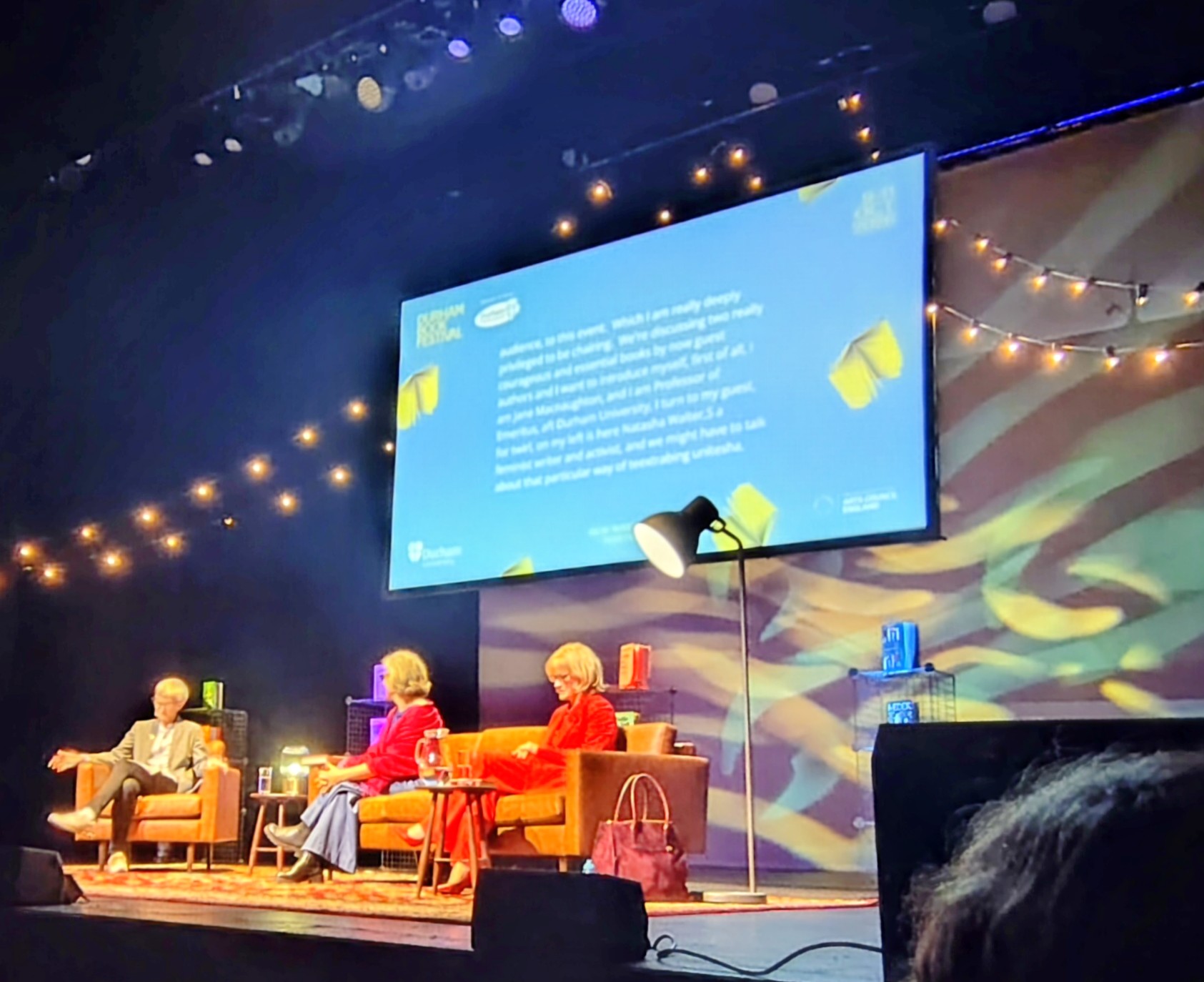
A brilliant pair of feminist writers featured at New Writing North‘s DurhamBookFestival yesterday, expertly hosted by Durham University‘s Emeritus Professor Jane Macnaughton, drawing out the common threads in the work of the very fabulous Natasha Walter and Clare McGlynn.
What stood out for me:
💡 The way in which seemingly disparate global issues such as the climate crisis and increasing political instability and violence can also be related to the issue of violence against women and girls, as the latter tends to increase in the aftermath of disasters and when heat rises.
💡The idea that the individualist messaging of lean-in-style feminism just places more pressure on individual women to work harder to be fine / do well / make an impact and obscures the reality that we’re facing huge interconnected global crises and systems that require a collective effort.
💡Government emphasis on economic growth as the means to solve social problems is problematic when the unpaid care work that is mostly performed by women is not measured within the standard calculation of a given country’s economic growth.
💡The porn that has become increasingly mainstream privileges male entitlement to sex and to a large extent, is more about power than pleasure, eroticising women’s humiliation and degradation in a twisted reinforcement of old-fashioned patriarchal norms.
💡The frequent sexual strangulation that is resulting from its normalisation within mainstream porn has been seen in MRI scans to be giving young women brain damage. At the same time, a significant number of young men are also saying that porn is negatively impacting their lives.
And the one we really need to help us not be entirely depressed by this picture:
💡 Patriarchy is not inevitable. If things have changed for the worst, that also means it is possible for them to change for the better. Natasha shared an inspiring example of a women’s movement in Syria spearheading the recovery of a more equitable society following Assad’s destructive regime, which I look forward to reading about in her book.
It wasn’t easy listening. And I don’t imagine it will be easy reading.
But it absolutely underlines the importance of the work we do in promoting healthy relationships, deconstructing gender norms and exploring healthy versus harmful sexual attitudes and behaviours.